

The Discovery Institute runs a website called “Evolution News” which declares itself the “intellectual home of the Intelligent Design community.” Although the vast majority of the scientific community considers Intelligent Design (ID) a pseudoscientific theory akin to creationism, the Discovery Institute insists that ID is a scientific idea, not a religious one and the Evolution News website pushes this claim very hard. Even US courts disagree, acknowledging that ID is far outside the scientific mainstream and must not be taught as science in public schools.
The Evolution News website is constantly attacking “Darwinists” and “evolutionists.” To be sure, scientists occasionally use the terms “Darwinist” and “Darwinism,” but usually in a very narrow context and never to define a community of scientists. The term “evolutionist,” on the other hand, is only used by those attacking modern evolutionary study, which is the unifying principle of all contemporary life science.
My writing on evolution has drawn the ire of creationists and ID proponents before, including Ken Ham. However, over a six week period, the Discovery Institute attacked me in ELEVEN many articles, nine lots of which where entirely dedicated to my articles, my recent book, or me personally. (I have collected the links to many of these articles here in the “media” section, but I stopped clicking on the Google alerts after a while.)

They also dedicated a podcast episode to attacking my recent article in the Wall Street Journal. About two minutes in to the podcast, the guest said, “I’m not going to get into any of the specific points he raised…” I wish he had, because the points I raised in that article and in my book have extremely interesting explanations if you understand the body as having a long evolutionary history. But if you view the body as the product of intentional design, some of our rather glaring flaws are puzzling, to say the least.
I have responded twice before (here and here) and I have decided to again, but this may very well be my last time. I never had the illusion that my counter-arguments would convince any of the folks at the Discovery Institute. I know that I can be overly confident, but I’m not so cocky to believe that, after all these years, I’ll be able to swoop in and quickly change their minds about the thing that their entire institute is all about. Instead, my rationale in responding is simply to make it clear that I am not dodging their critiques, nor am I left dumbfounded by them. It is probably little more than an overly developed sense of pride that drives me to defend myself.
Only two of their articles include specific scientific challenges to my claims, so these are the two that I will specifically discuss here. An MD wrote these two articles and many people find MDs to be very trustworthy and knowledgeable about biology. This is partly why I am motivated to respond.
In one very short post, the good doctor responds to an article I wrote about external testicles, a topic not covered in my book. I raise the real cost that external testes brings to men. The “reason” why testes are external in most (but not all!) mammals is that sperm development (and storage, as Dr. Egnor points out) is optimal at a slightly lower temperature than our balmy 37°C body temperature.

My point in that article is that there is no magic reason why that HAS to be so. To believe that external testes were intelligently designed to match the optimal temperature for sperm development is to pre-suppose that there is such a thing as the “optimal temperature for sperm development” as a fixed property separate from the cells and tissues that actually perform it. I said this in the article, but the doctor writes his post as though the ideal temperature of sperm development really is something fixed and the anatomy of the testicles is matched to that.
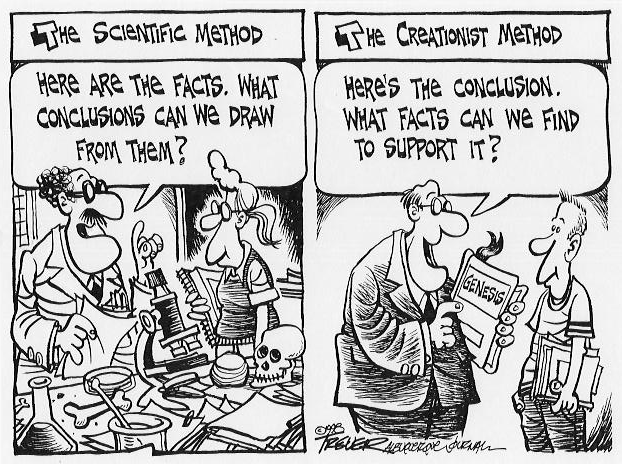
In other words, Egnor’s logic is exactly backwards, which is unfortunately very common among proponents of ID. They tend to approach their view of biology in the opposite way that mainstream biologists do. They approach biology through the lens of something they think is true (Intelligent Design) and then attempt to interpret evidence in accordance with that belief. Standard scientific practice works the other way around: we collect and consider evidence and then we attempt to figure out where the data is leading us. Although the cartoon below is meant as mockery, in my view, it captures the basic difference in the two approaches.
To expand on the issue of external testicles… the “optimal temperature” of any biological process is not set in stone as some fixed property. 35-36°C is the optimal temperature for sperm development because sperm development has evolved at that temperature. The enzymes and other components have evolved structures that are most functional at that temperature. Those that don’t believe in evolution frequently claim that this is circular logic, but it’s definitely not…
Consider exothermic animals (previously called cold-blooded). Because they don’t have a steady body temperature, most of their enzymatic processes are more robust than ours such that they can tolerate the wide temperature swings throughout the day and throughout the year. Even more to the point, we find that the “optimal temperature” for things like sperm development is highly variable among those animals. Those that live in colder climates exhibit different “optimal temperatures” than those that live in warmer ones. It’s not a fixed property. That’s how natural selection works – in response to environmental pressures, species adapt, if they can. Not surprisingly, there are virtually no exothermic animals with external testicles.
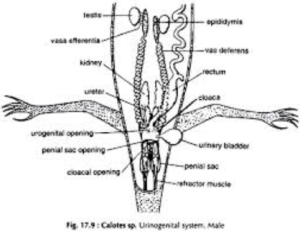
Another point to consider. Plenty of warm-blooded mammals (and all birds!) ALSO have abdominal testicles, for example sloths, elephants, and most marsupials. They do just fine. If the optimal temperature for sperm development is fixed at roughly 35.5ºC, wouldn’t these animals be in trouble? In fact, the optimal temperature for sperm production – in those animals – is different than it is for us. It is right where it should be because sperm production has been optimized for their body temperature by natural selection. This is the basic principle of adaptation.
The evolution of endothermy – warm bloodedness – is extremely interesting and the testes tell part of that fascinating story. In the reptilian ancestor of mammals, the testicles were inside the abdomen like they are in present-day reptiles. The explanation that currently seems most likely is that the testicles descended in order to escape an abdomen that was warming up as early mammals established their balmy core body temperature in the high 30s (celsius).
That just happened to be the solution that evolution came up with in most mammals, rather than tweaking the enzymes of sperm development to make them work well at the rising abdominal temperature. But it just as well could have worked out the other way, as it did for basically all other enzymes and body processes (including oocyte development, btw.). It was just a fluke and the point of this whole discussion is that evolution is aimless, random, and clumsy. I consider external testes to be a suboptimal solution because, of the available solutions to this challenge, it brought some new problems with it: both inguinal hernias and testicular damage are much more common than they would be if our testes had stayed inside.
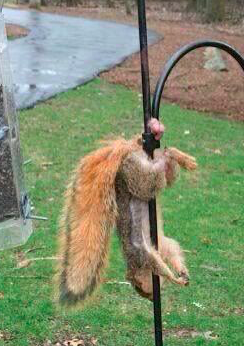
But hey, at least now there is an article out there entitled, “Nathan Lents and the Wisdom of Testicles.” I rather like that!
***
Dr. Egnor wrote another post as well. This time, he took issue with my claims about poor mucus drainage in the maxillary sinuses, which is a chief reason why humans get the “common cold” and sinus infections way more than any other animal. (You can read different versions of my argument here, here, and here.)
On this point, Dr. Egnor makes more mistakes in his article that have nothing to do with evolution. What initially made me angry about this was not the article itself (although it is very insulting to me – I wonder what his mother thinks), but how a staff member of the Discovery Institute said that he had “shellacked” me, shown here:

Egnor accuses me of doing science “with the parking brake on,” whatever that means, and attempts to explain how I have the maxillary sinuses all wrong. But that is not the case and the very source that Dr. Egnor uses agrees with me, not him. Below I describe the four mistakes he made, all of which completely undermine his argument.
[Another Edit: The DI finally got around to answering this post. They did correctly point out one mistake I made in terminology, which they make a huge deal out of, and which I have corrected in the text below. Then they write a great deal more using selective and misleading quoting of their source to advance a new idea that drainage in the maxillary sinuses actually works by… actually, I’m not going to try to summarize their idea because it’s very convoluted and self-contradicting. The drainage pattern they describe would make Rube Goldberg blush. Needless to say, the drainage doesn’t work that way and if it did, it would be an even worse “design” than we thought.]
First of all, if a careful reading of his source reveals that most of it has to do with accessory drainage in the ethmoid, sphenoid, and frontal sinuses, not the maxillary sinuses. The three are quite different from the maxillary sinuses because they are higher than the point at which they drain, while the maxillary sinus must drain mucus upward. Talking about this as one big system is not appropriate because the drainage processes are different. Of course they do join up, but that’s further downstream than the issues I often discuss.
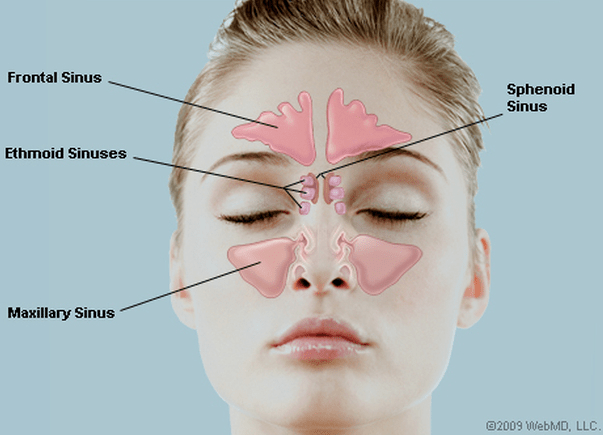
Although they are all connected through narrow passageways, they are each distinct chambers. Once again, just to be super clear, the source he quotes is mostly talking about the the ethmoid and sphenoid sinuses, when my original point was about the maxillary ones. Here is the full title of the paper he cites:
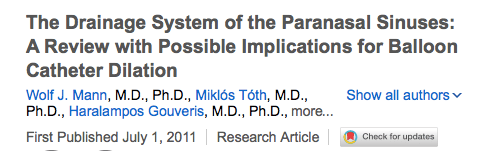
Secondly, Egnor claims that there are additional drainage points at the bottom of the maxillary sinuses that serve as the main drainage point for the chambers. This simply isn’t true. Now, to be sure, there are sometimes accessory ostia (openings) for drainage of the maxillary sinuses but the very name – accessory maxillary ostia – emphasizes the secondary nature of their function, compared to the large primary ostium which is indeed placed at the top of the chamber.

The third mistake that I must point is that most people don’t even have accessory maxillary ostia. Estimates vary, but this study found that 18% of cadavers had one accessory ostium. This study found just 5% of do. In fact, it appears that this secondary drainage point is opened as a result of chronic sinus infection. (The kind of infections made common by poor drainage in this cavity.) This study found that nearly 25% of people with chronic rhinitis had the additional openings. This study found it was 30%. The point is that most people don’t have any accessory openings in the bottom of the maxillary sinuses, as Dr Egnor claimed.
Lastly, Egnor claims that the primary maxillary ostium – the main drainage port – is only for “overflow” that occurs when the chamber completely fills with mucus, like the overflow hole at the top of a sink. This cannot be true, given the points above. However, by making this claim, Egnor contradicts even himself by emphasizing that drainage is not by gravity, but by ciliary action. Prior to this point, he had been emphasizing the role of additional drainage points at the bottom of the chamber, thus working in concert with gravity, but now he claims that cilia propel the mucus upward to the primary ostium (which is indeed what happens because that is the only drainage duct).
[Edit: the new post from the DI harbors many of these inconsistencies throughout the article. I spotted at least four times that they emphasize a point that actually contradicts an earlier point. When your goal is to score points on a debate, rather than get the science correct, that is bound to happen.]
The reality is that, when things are healthy and moving, cilia indeed propel the thin clear mucus upward to the primary drainage ostium, working against gravity but usually successful in doing so. However, when the mucus gets thick and filled with particulates, the cilia cannot win against gravity and drainage slows. The accessory ostia, when present, are tiny. Even the primary ostium is extremely skinny in humans compared to other animals (another flaw!), and eventually clogs up as well.
In summary, the primary ostium is not an overflow drain because all or most of the mucus drains through it (and the paper he cites says this). Secondly, in no other animal that I’m aware of, and definitely not in the other apes, is an ostium placed at the top of a sinus chamber. If Egnor were correct, we’d expect to see this weird convoluted system in other animals. In fact, chimps, orangutans, and gorillas all have a better arranged mucus drainage system than we do: it works more in concert with gravity and has wider drainage tubes. That’s probably the main reason why they don’t get colds and sinus infections as often as we do.
-NHL





 The Human Evolution Blog
Leave a comment