
Humans like to think of ourselves as the only animal that speaks to each other using language. It’s one of the things that “separates us from the animals,” so the saying goes. However, we already know that lots of other animals communicate with each other using vocal-auditory communication. Further, we’re beginning to learn that other ape and monkey species use distinct words and phrases with unambiguous meanings. In other words, they have vocabulary, which is among the basic requirements for language development.  Human speech, however, is definitely a cut above other animal modes of communication. It has grammar, tense, mood, and elaborate phrasing relationships that open limitless possibilities for expression. Importantly, speech itself is not required for all of this communication richness; sign language has it also and some anthropologists believe that gestural language developed in humans before spoken language. Aural and sign language are processed by the brains similarly.
  Our very anatomy has evolved to accommodate and enrich our speech. Many of the sounds that we make, particularly vowel sounds, cannot be made by other apes. Their throats are too shallow and their voice boxes too high. In the ancestry lineage of human evolution, the adaptation of our throat anatomy to facilitate speech (as we know it) occurred quite recently.
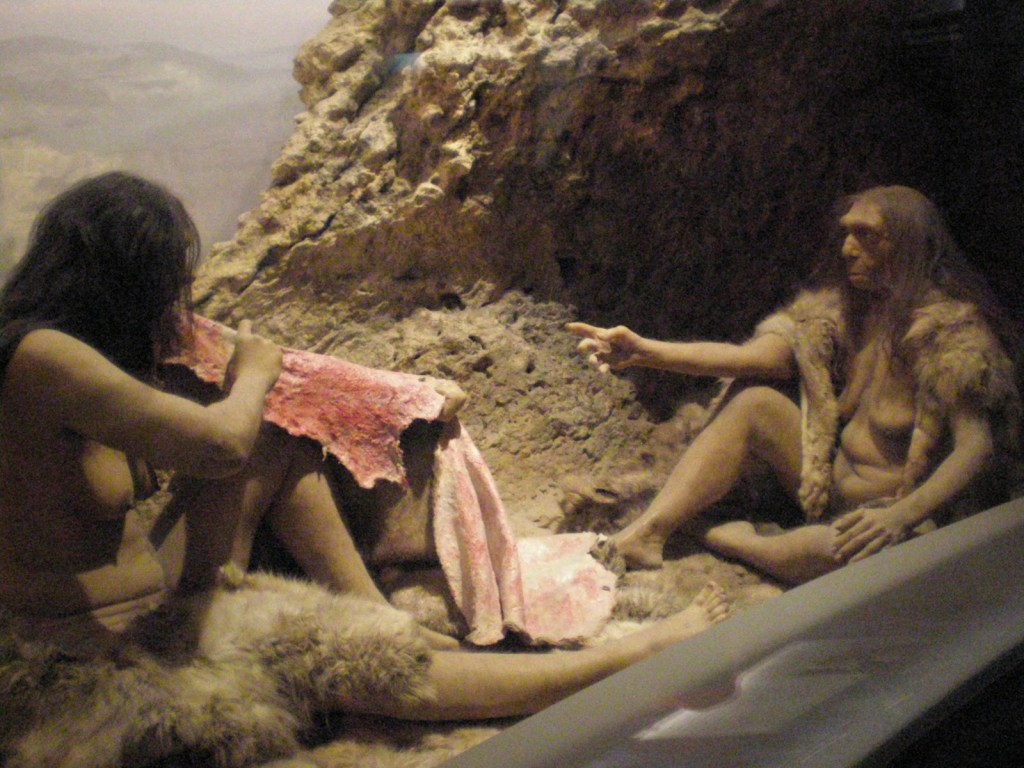
The fossilized remains of Homo habilus, Homo erectus, Homo heidelbergensis, and others, exhibit a throat structure closer to other apes than to humans. It is unlikely that they could speak as we do. What about Neanderthals? Neanderthals are our closest cousins, separated by 500,000-700,000 years of separate evolution (with some interbreeding, especially toward the end of Neanderthals around 50,000 years ago). If any non-human species could speak, Neanderthals would be the most likely candidates.  The common perception of Neanderthals is that of brutish dimwits who communicated by grunts and growls. This characterization could not be more wrong. Neanderthals lived in social communities with a complex lifestyle. They wore clothing, made jewelry, used tools, hunted big game in a coordinated fashion, and made drawings on cave walls. They even buried their dead (and some maintain that they did so with trinkets and ornamentation, indicating funerary customs, a telltale sign of religious belief, though this is controversial). Neanderthals even had bigger brains than we have, though that does not mean that they were more intelligent.
But did they speak and use language? There has been no discovery of Neanderthal writing, but that doesn’t really say anything. Humans didn’t invent writing until a few thousand years ago, despite having a spoken language for hundreds of thousands of years. Our brains are hard-wired for language acquisition through listening and speaking, not reading and writing.
Children spontaneously learn to speak, but they have to be arduously taught to read and write. So how can we ever know if Neanderthals spoke? One line of evidence is the anatomy of their throat. Speech, at least as we know it, depends on certain anatomical arrangements.
The throat of the modern human is not the only arrangement that would allow speech, but it does teach us about what kind of sounds can spring from different tissue architecture. Research into the relationship between anatomy and speech in extinct species centers around a few bones in the throat. Bones are our only resource for these questions because soft tissue does not fossilize well. (It doesn’t fossilize at all usually.)
Meet the hyoid bone: 
The hyoid bone is a semicircular bone located high in our throat. It’s quite strange, as bones go, because it is not firmly attached to other bones. Instead, it is the central anchor for a variety of muscles in the throat, face, larynx, and tongue. As such, it is central for the formation of sounds, as well as swallowing, gagging, coughing, and other things we do with our throat.
Although scientists haven’t reached complete agreement about the precise role of the hyoid bone in the formation of the rich variety of sounds that various hominids can make, the hyoid definitely does tell us something about the structural and spatial arrangements in the anatomy of the throat. If we also have the jaw bone and larynx, scientists can often deduce what kind of sounds an animal can make.
Several Neanderthal hyoid bones have been found over the years, and scientists from the University of New England recently analyzed them using high-resolution X-rays and three-dimensional computer modeling. This allowed the scientists to see inside the hyoid bone as well as subtle features on its surface, which indicate points of attachment to the various musculature.  From this, the scientists were able to conclude that the hyoid bone was as low in the throat of Neanderthals as it is in modern humans. Since we know that the hyoid bones of what we believe is our common ancestor with Neanderthals is much higher, this is an example of convergent evolution.
Both humans and Neanderthals experienced a steady drop in the position of their hyoid bones. Does this mean that Neanderthals could speak like we can? No one can say for sure, but this is definitely a strong piece of evidence that they could. It is fascinating to ponder Neanderthals conversing with one another in a rich language of sounds not unlike our own.  This is also a nice reminder of how much speech benefits survival and success. Both humans and Neanderthals experienced the same anatomical change in their throats in a relatively short amount of time. This means that the selective pressure was strong. Individuals who could speak more clearly and elaborately left more offspring than those whose speech was more rudimentary.
Speech also goes hand-in-hand with intelligence. It’s probably the most cognitively advanced thing that is hard-wired into our brains. In fact, most anthropologists agree that the “great leap forward,” which ushered in the modern era of human existence, was due to the final cognitive advances that allowed complex language.
The great leap forward occurred between 50,000 and 75,000 years ago in the lush fields of the African savannah. The Neanderthals might have made that leap before we did. If we are unlocking the secrets of their hyoid bone correctly, Neanderthal anatomy developed for speech before Homo sapiens did. While our cognitive development undoubtedly surpassed theirs later, there is good evidence that they were speaking with elaborate language before we were.
Indeed, this seems likely because their artwork is older, their funeral rites are older, and they developed advanced tools before we did. This is just one more piece of evidence that Neanderthals were nothing like the ignorant brutes they are often portrayed as.
-NHL (@nathanlents)





 The Human Evolution Blog
Leave a comment