
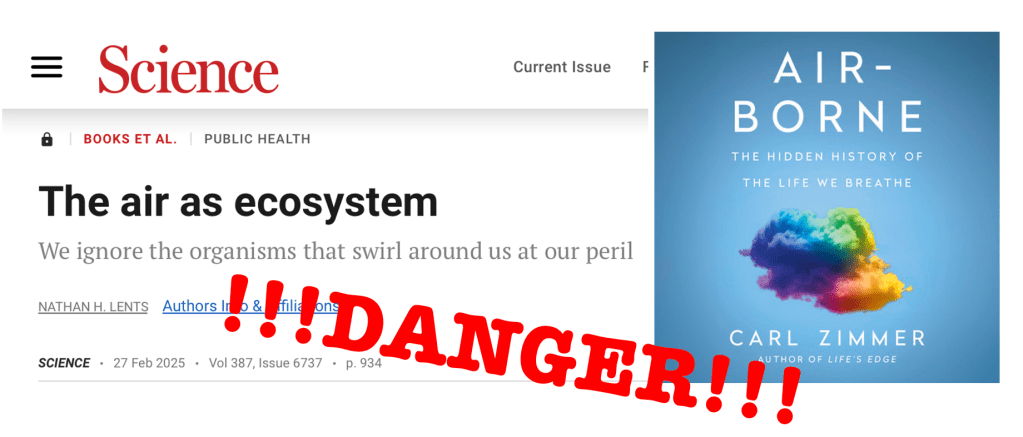
Carl Zimmer is perhaps the greatest – and certainly the most prolific – science journalist of our era. Many of you will know him from his regular New York Times columns on the latest discoveries and breakthroughs in the life sciences.

If you haven’t yet, I hope you also consider reading his books, which I have no idea where he finds the time to write. When Zimmer tackles a subject, he really tackles a subject, reaching as far back as the history goes, while also bringing readers fully up to date with the latest advances and the current state of knowledge. As such, his books are often quite long. But, since they’re written in an engaging and narrative style, they’re also hard to put down. You’ll read them faster than you expect to.
Three books ago, he wrote She Has Her Mother’s Laugh, which covers human genetics completely than I’ve ever seen it done. After covering the long (and quite disturbing) history of the field, Zimmer brings readers fully into the genomics era, even having his own genome sequenced in service to his research for the book. I have been studying genetics professionally for more than two decades and I learned so much that I immediately started assigning it in my courses.
In 2018, I met Carl at a launch party for that book and later that year, we ended up doing an event together at the 92nd street Y. I was the moderator of the event, but Carl was the real star. The event sold out.

His new book is entitled Air-Borne: The Hidden History of the Life We Breathe and I had the pleasure of reading it before it was released, because I was tasked with reviewing it for Science. For that review, my word limit was short, so here I describe in more detail some of what I most loved in the book.
Air-Borne is at once a popular science book, a historical monograph, a public policy lesson, and a comprehensive primer on the subdiscipline known as aerobiology. You can be forgiven for not knowing much about the life that floats around you because, as Zimmer explains, none of us do.
Like most scientific areas, aerobiology has its roots in ancient writings, but burst onto the public stage (literally) through the showboating of Félix Pouchet and Louis Pasteur during the great debates on spontaneous generation. Pasteur’s veal bouillon and swan-necked flasks are famous, but lesser known is his journey to the top of a glacier to see if life teemed in the air there, too (spoiler alert: it does). Also included are colorful and informative historical anecdotes about the work of Robert Koch, Joseph Lister, John Snow, and many others.

Unsurprisingly, much of the research on airborne life is, and always has been, focused on how pathogens spread, beginning with the bubonic plague and Small Pox. What is surprising is how often – and how badly – we have gotten things wrong.
The World Health Organization’s assurance, as late as March 28th, 2020, that “COVID-19 is not airborne” was like a loud echo of Benjamin Rush, America’s first famous physician, declaring that the Yellow Fever outbreak of 1793 was due to bad air emanating from a shipment of rotten coffee beans. Just as the industrial revolution gave us the metropolis and its cesspools of infectious diseases, the scientific revolution gave us the microscope and other methods to study them.

Even so, the truth about the air around us would remain elusive for centuries. As contagionists, miasmatists, and sanitarians staked out their positions, pandemics and plagues raged almost completely unabated. The quarantine, first invented as a 30-day hold to prevent entry of the Black Death into Dubovnik, Croatia and later expanded by Italians to 40 days (quarantino), was a spectacular success. Somehow, five centuries later, in 1824, Yellow Fever quarantines were called “willful murder,” another refrain with a familiar echo.
Zimmer continues his tour through other scourges including tuberculosis, pertussis, measles, and chicken pox. The fact that physicians were unknowingly using the same approaches in their attempts to characterize pathogens of widely different natures – viruses, aerobic and anaerobic bacteria, and fungi – all without appreciating the risk of cross-contamination within their own facilities, made certain the results would conflict, contradict, and confuse.
The confusion and contradictions have persisted to this decade. As SARS-CoV-2 raged, scientists, physicians, and the public health establishment could not even manage to use the term airborne consistently. Most contagions are spread through direct contact with infected persons or contaminated fluids, objects, or surfaces. Others hitch a ride on the respiratory droplets that form during speaking, sneezing, or coughing (but not usually by quiet breathing). But these droplets can perniciously spin off smaller aerosols known as droplet nuclei, which are just a few microns in diameter and can waft long distances and be carried in updrafts.

Influenza, SARS, and the common cold can be spread by all three modes, but, shockingly, we still don’t know the relative contribution of each. Given how many people die from respiratory infections each year, our continued ignorance of the precise mode of airborne transmission is nothing short of a scientific scandal.
The public policy sandals are worse. Just as the 21st century began, it got an epidemic of its own, SARS. Although largely contained to Southeast Asia, SARS-CoV-1 should have been the wakeup call that taught us how to kill a pandemic in its cradle. Instead, the moment was squandered as bioterrorism threats were all that mattered in the years following September 11th. Neither SARS, nor MERS, nor Ebola, nor the H1N1 or H5N1 influenza strains could compete with Anthrax and Small Pox for federal funding. With palpable frustration, Zimmer describes an ambitious 2005 speech by George W. Bush announcing a generous budget for pandemic preparedness, but it included almost no new funding for research into determining precisely how respiratory infections spread. Officials assumed we knew.
Zimmer’s reporting is at its most penetrating when he finally brings us to Wuhan in December 2019. Officials at the Chinese Ministry of Health, the US Center for Disease Control, and the World Health Organization, while trying to warn but not alarm, put their ignorance of respiratory transmission on full display. Zimmer describes the efforts, almost totally in vain, of Group 36, the aerobiology experts that tried to warn the world that SARS-CoV-2 is an airborne pathogen, spread not just through fluids and droplets, but by quiet breathing.
We all know what happened. Officials at the NIH, CDC, WHO, and everywhere else were stuck in the mindset that true airborne transmission was rare or impossible, and the public was told to focus more on handwashing and disinfecting surfaces than donning masks and respirators, even, for far too long, in hospitals and nursing homes.
The final three chapters of Airborne are a comprehensive scientific history of COVID-19 informed by personal interviews with many officials, physicians, and scientists, including members of Group 36. Spooked by the narrowly averted dangers of SARS, the Obama administration had developed a solid pandemic response plan that, had it been fully funded and implemented, may have blunted the early spread of COVID-19. But it was quickly shelved by the Trump administration and the strategic national reserve of critical supplies – especially surgical masks and N95 respirators – was allowed to dwindle.
Although the rapid development of incredibly safe and effective vaccines remains a scientific triumph, Zimmer hauntingly recounts how, on most other scores, especially public resistance to vaccination, quarantines, and masks, we are worse off now than we were five years ago. Should another pandemic emerge, it will almost certainly be through the air.





 The Human Evolution Blog
Leave a reply to Jonathan Siklos Cancel reply